Best Wet Hair Brush for Hair Loss: Bristle Flex

Five wet detangling brushes compared on bristle flex, head width and weight, with a named winner and the conditions that flip the pick to something else.
By Mateo CallahanUpdated 15 min read
On this page
- Best wet hair brush for hair loss at a glance
- How I screened this shortlist down to five
- Why bristle flex matters more than bristle count
- 1. Wet Brush Original Detangler Hair Brush — Best overall
- 2. Tangle Teezer Ultimate Detangler Brush — Best premium
- 3. Kitsch Flexi Flow Detangler Brush — Best for pros
- 4. Wet Brush Ceramic Speed Dry Detangler — Best upgrade
- 5. Ninabella Detangler Brush — Best minimal setup
- Can a brush actually stop hair from falling out?
- How should you brush wet hair to lose less of it?
- Wet Brush Original vs Tangle Teezer Ultimate: which wins?
- The verdict
- FAQ
The best wet hair brush for hair loss is the Wet Brush Original Detangler, because its flexible IntelliFlex bristles give way at the knot instead of dragging strands out of the follicle, and at 2.4 oz it's light enough to steer with a slack wrist. If you detangle while the dryer is running, the Wet Brush Ceramic Speed Dry is the better buy. The misconception worth clearing up first: shoppers compare bristle counts and ball tips, and neither one decides this. Flex does.
Best wet hair brush for hair loss at a glance
| Pick | Bristle setup | Weight | Price |
|---|---|---|---|
Best overall Wet Brush Original Detangler Hair Brush |
IntelliFlex, 55% less breakage claim | 2.4 oz | Check Price |
Best premium Tangle Teezer Ultimate Detangler Brush |
Two-tiered teeth, regular flex | 1.41 oz | Check Price |
Best for pros Kitsch Flexi Flow Detangler Brush |
Bendable frame, ultra-smooth bristles | 2.15 oz | Check Price |
Best upgrade Wet Brush Ceramic Speed Dry Detangler |
HeatFlex, vented ceramic body | 2.72 oz | Check Price |
Best minimal setup Ninabella Detangler Brush |
Flexible bristles, rounded tips | 2.12 oz | Check Price |


How I screened this shortlist down to five
I started from the wet-detangler listings in Amazon's Hair Brushes category and lined up the published specifications side by side: weight, head dimensions, bristle description, colour and model. Anything that couldn't state a weight or a head size didn't make the cut, because those two figures are what you actually feel in your hand at 7am with a scalp full of knots.
What survived is a set of five brushes with a genuinely tight spread. The lightest is the Tangle Teezer Ultimate at 1.41 oz. The heaviest is the Wet Brush Ceramic Speed Dry at 2.72 oz. That's a difference of about 1.3 oz across the whole field, which sounds trivial and isn't: a lighter head means less downward force per stroke, and force is what pulls.
Head width tells a similar story. Four of the five sit between 2.56 and 2.99 in wide. The Wet Brush Original is 2.8 in, the Ninabella 2.76 in, the Kitsch 2.72 in. Nobody here is a paddle brush.
Three things I could not screen for, and neither can you from a listing:
- Actual bristle stiffness in grams of deflection. No brand publishes it.
- How the bristles hold up after 200 washes.
- Whether the handle stays put in a soapy hand.
Why bristle flex matters more than bristle count
Bristle flex is the amount a single bristle bends before your hair does. That's the whole game with a wet hair brush for hair loss. Wet hair stretches further than dry hair before it snaps, which makes it feel forgiving right up to the moment a strand parts at the knot.
A rigid bristle meets a tangle and transfers your full arm force into a few strands. A flexible bristle meets the same tangle and bends sideways, spreading the load. Wet Brush calls its version IntelliFlex and claims 55% less breakage. Tangle Teezer describes patented two-tiered teeth, with long flexible teeth doing the detangling and short teeth smoothing behind them. Kitsch takes a different route and flexes the entire frame rather than the bristles alone. Ninabella describes flexible bristles with rounded tips.
Four of the five picks here build their pitch on flex. That's the tell.
Bristle count, by contrast, appears on none of these five listings, and that's fine, because more bristles in a rigid head just means more rigid contact points. Here's what to compare instead, in order:
- Does the listing describe flexible bristles or a flexible head? If not, move on.
- What does the brush weigh? Under 2.5 oz keeps stroke pressure low.
- How wide is the head? Narrow heads reach the nape without twisting your wrist.
- Is it rated for wet use specifically, or just tolerated?
1. Wet Brush Original Detangler Hair Brush — Best overall
The most flexible-bristle detangler in this set at the lowest price position, and the one buyers here choose most often.
Best for: long, tangle-prone hair brushed straight out of the shower Skip it if: you brush while blow-drying and want one tool for both
Within this set, the Original wins on the combination of low weight and low price position. It's 2.4 oz with a 1.6 x 8.8 x 2.8 in body, so the head is narrow enough to work around the back of your skull without rotating your wrist into an awkward angle. That matters. Awkward wrist angles are where people start yanking.
Wet Brush says the IntelliFlex bristles glide through tangles with 55% less breakage, and that the flexible bristles protect against split ends. Those are the manufacturer's claims, not measured results, but the design logic behind them holds: bristles that deflect sideways don't need you to pull harder. The listing describes it as working on straight, curly, textured, thick and wavy hair, and it's the cheapest of the five here.
It also sells faster than anything else on this list by a wide margin.
The trade-off is scope. This is a wet and dry detangler and nothing more. It has no vents, no ceramic plate and no blow-dry rating, so if your routine is brush-while-drying, you're buying the wrong Wet Brush. Only one seller lists it, too.
Pros:
- Cheapest of the five picks here
- 2.4 oz, second-lightest in the set
- Narrow 2.8 in head reaches the nape easily
- IntelliFlex flexible bristles per the listing
- Listed for straight, curly, textured, thick and wavy hair
Cons:
- No vents, so it isn't a blow-dry brush
- Only one seller lists it
- No published warranty
- Bristle firmness never quantified by the brand
2. Tangle Teezer Ultimate Detangler Brush — Best premium
The lightest brush in this set at 1.41 oz, with a two-tier tooth design nobody else here uses.

Best for: straight to wavy hair and in-shower conditioner distribution Skip it if: you need a handle you can grip with a wet hand
At 1.41 oz this is meaningfully lighter than everything else here, and the gap is real: it's about 0.7 oz under the Wet Brush Original and roughly half the weight of the Ceramic Speed Dry. Less mass in the head means less momentum behind each stroke, which is exactly what you want when the strand at the tip of the knot is the one you're trying to keep.
The design is also the odd one out. Tangle Teezer describes patented two-tiered teeth: long flexible teeth to break the knot apart, short teeth behind them to smooth the strand. The brand positions the brush's teeth as regular-flex and aimed at straight to wavy hair, and calls it out specifically as a shower brush for distributing conditioning treatments and masks. That second use is a genuine differentiator in this group. Nobody else here makes the product-distribution case.
Body dimensions are 8.66 x 2.56 x 1.57 in, making it the narrowest head of the five.
Two honest limits. It's the most expensive pick here, and the brand's own copy pitches the tooth flex at straight to wavy hair, not the thickest textures, so very coarse hair may want the Kitsch instead. It's also the oldest listing in this set, released in 2018.
Pros:
- Lightest here at 1.41 oz
- Narrowest head at 2.56 in
- Two-tier tooth design unique in this set
- Listing calls out product distribution in the shower
- Two sellers stock it, more than any other pick
Cons:
- The most expensive pick here
- Tooth flex aimed at straight to wavy, not coarse hair
- Oldest listing of the five, from 2018
- No published warranty
3. Kitsch Flexi Flow Detangler Brush — Best for pros
The only pick here that flexes the whole frame rather than just the bristles.

Best for: curly and coily textures that need the head to bend with the scalp Skip it if: you want a long published track record on the listing
Every other brush in this roundup flexes at the bristle. Kitsch flexes at the frame, describing a bendable body that adapts to your scalp for smoother detangling with less pulling. That's a structurally different answer to the same problem, and it's why this one earns its place. A frame that follows the curve of your head keeps more bristles in light contact instead of a few in hard contact.
The brand also positions it repeatedly for curly and coily hair, and says it can be used wet or dry to preserve the cuticle. Those are the manufacturer's claims. What I can verify from the specifications is the shape: 8.86 x 1.5 x 2.72 in, the longest body here at 8.86 in, and the shallowest at 1.5 in. Long and shallow is a good combination if you section your hair and work through it piece by piece, because the extra handle length gives you leverage without extra force.
Weight is 2.15 oz, third-lightest of the five.
Against the others, it's a premium price position with the least published history. No release year appears on the listing, and one seller stocks it.
Pros:
- Only bendable-frame design in this set
- Longest body at 8.86 in for sectioning reach
- Shallowest profile here at 1.5 in
- 2.15 oz, third-lightest of the five
- Brand positions it for wet or dry use
Cons:
- Premium price position with no extra published specifications
- No release year on the listing
- Only one seller lists it
- Frame flex isn't quantified anywhere
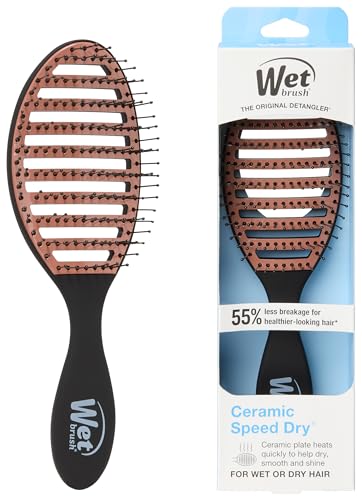
4. Wet Brush Ceramic Speed Dry Detangler — Best upgrade
The one pick built to be held under a running dryer, with heat-resistant bristles and a vented ceramic body.
Best for: anyone who detangles mid-blow-dry rather than at the sink Skip it if: you air-dry and never point a dryer at your head
This is the upgrade path from the Original, and the difference is heat. Wet Brush describes HeatFlex heat-resistant bristles that are blow-dry safe, plus an open vented design and ceramic plates the brand says cut drying time by 45%. It repeats the 55% less breakage claim. Treat those percentages as marketing figures, but the vented, heat-rated construction is a real design distinction: it's the only pick in this set specified for use with a dryer.
Why that connects to shedding is simple. Fewer minutes of heat and fewer passes with a brush is less total mechanical work on the strand. If you currently detangle at the sink and then brush again through a blow-dry, you're doing the job twice.
The specifications are 1.59 x 8.77 x 2.99 in and 2.72 oz. That 2.99 in head is the widest of the five, which covers more hair per stroke but is slightly less nimble at the nape.
Two real costs. It's the heaviest brush here, and it sells slower than the Original by a large margin, which suggests most buyers in this category still want the plain detangler.
Pros:
- Only heat-rated, blow-dry-safe pick in this set
- Vented ceramic body per the listing
- Widest head at 2.99 in covers more per stroke
- Entry price position despite added construction
- Newest listing here, released 2024
Cons:
- Heaviest of the five at 2.72 oz
- 2.99 in head is less nimble around the nape
- Sells far slower than the Original
- Only one seller lists it
5. Ninabella Detangler Brush — Best minimal setup
A slim, recycled-body detangler built for the bag rather than the bathroom counter.

Best for: gym bags, carry-ons and a second brush for the desk drawer Skip it if: you want a brand with a long history in detanglers
The Ninabella's argument in this set is portability plus materials. The listing describes a light, slim, ergonomic grip that fits a purse, a travel bag or a carry-on, and says the body is made from recycled post-consumer plastic with nylon bristles and cardboard packaging. It's the only pick here that makes a recycled-material claim at all.
On the shedding question, it covers the fundamentals. Ninabella says the flexible bristles give way and glide through knots instead of ripping through them, and that rounded bristle tips glide gently over the scalp while detangling. Rounded tips matter more than people realise: a blunt tip skates over the scalp, a sharp one digs in, and irritating the scalp is a good way to make brushing feel worse than it needs to.
The measurements are 2.12 oz and 1.57 x 8.66 x 2.76 in, which puts it second-lightest and mid-pack on head width.
The catch is that it's mid-priced without the design differentiator the others have. No two-tier teeth, no bendable frame, no heat rating, no release year listed. It's a solid, competent brush in a field of brushes with a hook.
Pros:
- Only recycled-body claim in this set
- 2.12 oz, second-lightest here
- Rounded bristle tips described on the listing
- Slim 1.57 in profile suits a bag
- Mid price position, cheaper than two picks
Cons:
- No structural differentiator versus the other four
- No release year published
- Only one seller lists it
- Mid price for a plainer design
Can a brush actually stop hair from falling out?
No, and any listing that suggests otherwise is overreaching. Hair loss has causes a brush can't touch: genetics, hormones, thyroid function, iron levels, medication, stress. None of the five products here claims to treat any of that, and the search results for this keyword are really results for gentle wet detanglers, not for anything that addresses loss at the root.
What a brush can change is mechanical breakage, which is a different thing. Breakage is a strand snapping mid-length. Shedding is a whole strand releasing from the follicle. Both end up in the sink, which is why they get confused.
Two honest ways to tell them apart:
- A shed strand usually has a small pale bulb at one end. A broken strand doesn't.
- Broken strands are often shorter than your hair's full length. Shed strands run the whole way.
If most of what you find is short and bulb-free, the tool and the technique are worth changing. If it's full-length with bulbs, a brush is not your answer and a doctor is a better next call. Choosing the best wet hair brush for hair loss is about not making things worse, and that's a genuinely useful goal.
How should you brush wet hair to lose less of it?
Technique moves the needle more than any single product in this list. Wet hair is at its most stretchable and its weakest, so the sequence you use matters.
Work like this:
- Squeeze out excess water with a towel. Never rub in circles.
- Apply conditioner or a leave-in first. A lubricated strand slides; a dry one grips.
- Split hair into three or four sections and clip them.
- Start at the ends. Brush the bottom two inches until they run clear.
- Move up two inches at a time, ending at the roots.
- When a knot resists, stop pulling and hold the hair above it with your other hand.
That last step is the one most shoppers miss. Holding above the knot means the resistance stops at your fingers rather than at your scalp.
One more habit worth breaking. Don't rake a brush straight from root to tip on wet hair, because every knot in the path gets compressed into a tighter one as the bristles arrive. Ends first, always.
Wet Brush Original vs Tangle Teezer Ultimate: which wins?
This is the real decision in the category, and the two brushes answer the question differently.
The Wet Brush Original wins on cost, weight-to-price and reach. It's the cheapest of the five, weighs 2.4 oz, and its 2.8 in head with a conventional handle gives you a clean grip for working around the back of your head. It's also the pick buyers here choose most often by a very large margin. For long hair that goes straight from towel to brush, it's the default.
The Tangle Teezer Ultimate wins on lightness and on what happens in the shower. At 1.41 oz it's about 40% lighter, and its 2.56 in head is the narrowest here. Tangle Teezer's two-tier tooth design and its explicit pitch as a shower brush for distributing masks and conditioning treatments make it the better choice if your detangling happens with conditioner still in.
The cutoff is where you brush. In the shower with product in, take the Tangle Teezer. At the mirror afterward, take the Wet Brush Original.
The verdict
If your hair is long, straight to wavy and you brush it at the mirror after towelling, the Wet Brush Original Detangler is the pick. It's the cheapest of the five, weighs 2.4 oz, and its 2.8 in head with IntelliFlex flexible bristles is the most sensible combination of low pressure and easy reach in this set. It's also the brush buyers in this category choose far more often than anything else here.
If you detangle in the shower with conditioner still in your hair, the Tangle Teezer Ultimate Detangler is the better buy. Its exact advantage is mass: 1.41 oz against 2.4 oz, roughly 40% lighter, with a 2.56 in head and a two-tier tooth design built to spread product as it passes.
The cutoff is where the brushing happens. Wet and slippery with product in, Tangle Teezer. Towel-dried at the mirror, Wet Brush Original.
Two conditions flip both answers. If you brush while blow-drying, the Wet Brush Ceramic Speed Dry is the only pick here rated for heat, with a vented ceramic body. If your hair is curly or coily, the Kitsch Flexi Flow's bendable frame is the design that follows your scalp instead of fighting it.
FAQ
Is a wet hair brush worth buying if you're already shedding?
A wet hair brush is worth buying if the strands you're finding are short and snapped rather than full-length, because that pattern points to mechanical breakage a flexible-bristle brush can reduce. If you're seeing full-length strands with pale bulbs at the root, that's shedding, and no brush addresses the cause. Talk to a doctor about that instead.
What makes the best wet hair brush for hair loss different from a regular brush?
The best wet hair brush for hair loss differs from a regular brush in one respect: the bristles or the frame flex under load. Four of the five picks here build their design on that. A rigid bristle bed transfers your arm force into a handful of strands at the knot. A flexible bed bends sideways and spreads that force across many more.
Which weighs less, the Tangle Teezer Ultimate or the Wet Brush Original?
The Tangle Teezer Ultimate weighs less, at 1.41 oz against the Wet Brush Original's 2.4 oz. That's roughly 40% lighter and it's the largest weight gap in this set. Less head mass means less momentum behind each stroke. The Original counters with the lowest price position here and a slightly wider 2.8 in head for faster coverage.
Can any of these brushes be used with a blow dryer?
Only one of these brushes is specified for a blow dryer: the Wet Brush Ceramic Speed Dry. Its listing describes HeatFlex heat-resistant bristles that are blow-dry safe, plus open vents and ceramic plates the brand says speed drying by 45%. The other four are described for wet or dry use with no heat rating, so keep the dryer away from them.
What's the most common mistake people make brushing wet hair?
The most common mistake people make is raking from root to tip in one pass. Every tangle in the path gets pushed downward and compressed into a tighter knot before the bristles reach it, so the final tug is the worst one. Start at the last two inches, clear them, then move up in short stages until you reach the roots.
Pick the brush that matches where you actually brush, then fix the sequence. Ends first, sections clipped, a hand held above every stubborn knot. That combination does more for the strands circling your drain than any single feature claim on any of these five listings. The Wet Brush Original Detangler is the sensible default because it asks the least of you: 2.4 oz, flexible bristles, a narrow head that reaches the nape, and the lowest price position of the five. Start there, and change tools only if your routine genuinely puts you in the shower or under a dryer.