Best Wide Tooth Combs for Thinning Hair: Paul Mitchell Wins

Five wide tooth combs compared for thinning hair, ranked by tooth spacing, weight and material. The Paul Mitchell Detangler wins for most; four alternates cover budget, family use, heat styling and premium daily grooming.

By Mateo CallahanUpdated 15 min read
On this page
- Best wide tooth comb for thinning hair at a glance
- A note on the halal question
- How I screened the field
- 1. Paul Mitchell Detangler Comb — Best overall
- 2. Kent 16T Tortoise Fine and Wide Tooth Comb — Best premium
- 3. HYOUJIN 601 Carbon Wide Tooth Comb — Most versatile
- 4. SIMPOR Detangling Hair Comb — Best for families
- 5. AFT90 Carbon Fiber Cutting Comb — Best budget pick
- Why tooth spacing decides this, not bristle count
- How thinning hair changes what you should look for
- What to check before you buy
- Which pick fits which routine?
- The verdict
- FAQ
The best wide tooth comb for thinning hair here is the Paul Mitchell Detangler Comb, a 9.45 in, 1.41 oz wide-tooth design that Paul Mitchell says glides through wet or dry hair without pulling, which is exactly the failure mode that costs you strands. If you want one comb that handles both finishing and detangling on the same head of hair, the Kent 16T Tortoise pairs fine and wide teeth in a hand-polished 7.28 in body.
Best wide tooth comb for thinning hair at a glance
| Pick | Length | Material claim | Price |
|---|---|---|---|
Best overall Paul Mitchell Detangler Comb |
9.63 in | Not stated | Check Price |
Best premium Kent 16T Tortoise Fine and Wide Tooth Comb |
7.28 in | Cellulose acetate claim | Check Price |
Most versatile HYOUJIN 601 Carbon Wide Tooth Comb |
11 in | Carbon fiber claim | Check Price |
Best for families SIMPOR Detangling Hair Comb |
Not stated | Acetate claim | Check Price |
Best budget pick AFT90 Carbon Fiber Cutting Comb |
8.5 in | Carbon fiber claim | Check Price |


A note on the halal question
None of the five listings state that they are certified halal, and Amazon's search returned this set on a query that included the word halal, which means the search engine treated it as loose signal rather than a hard filter. That matters because a comb is a physical tool, and the halal concern for grooming tools usually comes down to material provenance: whether the plastic, resin or bristle is confirmed free of animal-derived binders and whether the manufacturer will say so on request.
You cannot decide that from a product page alone. If certification is a firm requirement, treat the picks below as candidates and email the brand for a material declaration before buying. Kent lists cellulose acetate, which the brand describes as plant-derived, and that is the most transparent material claim in this set. It is still not certification.
How I screened the field
I compared the five listings side by side on the fields that matter for shedding hair: overall length, weight, tooth pattern, and any material claim the brand actually publishes.
- Wide teeth had to be part of the design, not an afterthought on a fine comb.
- Overall length had to sit in the daily-grooming range, roughly 7 to 11 in, so the comb reaches from root to tip in one pass on medium-length hair.
- The listing had to publish enough specification to compare it against the others, or offer a strong material claim in place of that.
Two combs are dual-tooth designs (Kent 16T and SIMPOR), one is a dedicated wide-tooth detangler (Paul Mitchell), one is a styling comb with a wide and a fine end (AFT90), and one is a handleless carbon-fiber detangler that HYOUJIN says survives 230°C. That spread is the point: thinning hair is not one problem, and the right wide tooth comb for thinning hair depends on what the rest of your routine looks like.
1. Paul Mitchell Detangler Comb — Best overall
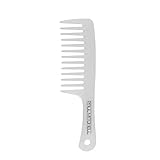
The Paul Mitchell Detangler Comb is the safest daily pick for thinning hair in this set: a dedicated wide-tooth design at a length that clears a full pass in one stroke.
Best for: daily detangling on fine, shedding hair Skip it if: you want a heat-safe styling comb
At 9.45 in and 1.41 oz, this is the longest single-purpose wide-tooth comb here, and the length matters when you are trying to move slowly from tip to root without tugging halfway through a knot. The listing dimensions are 0.1 x 9.63 x 2.5 in, so the body is thin enough to sit flat against the scalp without the wedge feel of a thicker acetate comb. Paul Mitchell says the teeth are designed to painlessly glide through hair without pulling and to prevent damaging breakage; both are manufacturer claims, but they line up with a dedicated wide-tooth geometry rather than a compromised dual-tooth one. The stylist tip on the listing is to use it to distribute masks and treatments, which is the second-most useful thing a wide tooth comb does for thinning hair, after gentle detangling.
The trade-off is scope. This is not a finishing comb, and it is not marketed as heat-safe, so if your routine ends with a blow-dryer and a comb in hand, the HYOUJIN below fits better. It is also the second most expensive pick here, which reads as a Paul Mitchell brand premium rather than a specification premium.
Pros:
- Longest single-purpose wide-tooth body in the set at 9.45 in
- Light at 1.41 oz, so wrist fatigue on long hair is low
- Thin 0.1 in profile sits flat against the scalp
- Explicitly a wide-tooth design rather than a compromise
- Paul Mitchell publishes the release year and full dimensions
Cons:
- Material is not stated on the listing
- No heat-resistance claim, unlike the HYOUJIN
- The second most expensive pick here for a single-purpose tool
- Single tooth pattern, so you still need a finishing comb
2. Kent 16T Tortoise Fine and Wide Tooth Comb — Best premium
The Kent 16T is the pick when you want one comb to do both jobs and you care about the material the comb is made from.

Best for: one comb that handles finishing and detangling Skip it if: you need a longer comb for very long hair
Kent publishes more useful detail than any other brand in this set. The 16T is 7.28 in long, 1.06 oz, and 0.2 in thick, with a dual-tooth pattern that puts wide teeth on one side for detangling and fine teeth on the other for finishing. Kent says the comb is saw-cut and hand-polished from cellulose acetate, which the brand describes as plant-derived rather than petroleum-based, and that both edges are buffed to soft rounded teeth. For thinning hair, hand-polished teeth are the specific detail worth paying for: injection-molded teeth carry a mold seam that catches on fine strands, and a polished tooth does not.
The 7.28 in length is where the trade-off sits. That is shorter than the Paul Mitchell and much shorter than the HYOUJIN, so if your hair is past your shoulders you will make more passes to clear it. Kent is also the most expensive pick in this set. The material claim, the polish, and the dual-tooth pattern together justify the position, but only if you actually use both tooth widths. If you never finish with a fine tooth, you are paying for a feature you do not touch.
Pros:
- Cellulose acetate claim, described as plant-derived
- Saw-cut and hand-polished teeth on both edges
- Dual fine-and-wide pattern replaces two combs
- Lightest of the five at 1.06 oz
- Brand publishes full dimensions and material
Cons:
- Shortest comb in the set at 7.28 in
- The highest price position of the five
- Fine teeth are unnecessary if you never use them
- Dual pattern means less wide-tooth surface per pass
3. HYOUJIN 601 Carbon Wide Tooth Comb — Most versatile
Pick this one if a blow-dryer is part of your routine and you want a wide tooth comb that will not warp against a hot barrel.
Best for: blow-drying with a comb in hand Skip it if: you prefer a comb with a proper handle
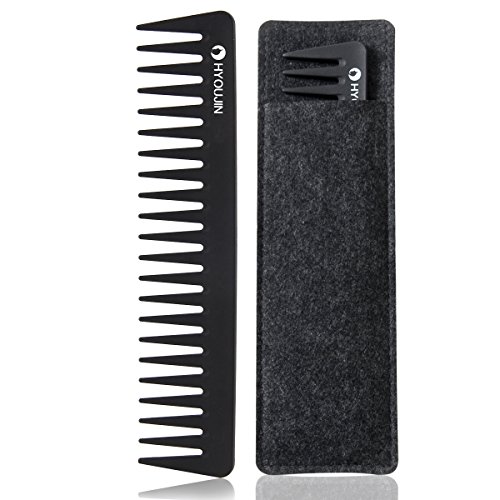
The HYOUJIN 601 is the longest comb here at 11 in, weighs 1.92 oz, and measures 0.39 in thick, which is the beefiest body in this set. HYOUJIN says it is made from carbon fiber and rated heat-resistant to 230°C, which is a useful spec if you rest a comb against the outlet of a dryer or work section by section with a warm airflow. The brand also markets an anti-static claim, which matters more than it sounds on thinning hair: static separates fine strands, and a static-free pass gathers them cleanly.
Two caveats to name. First, it is a handleless comb, so the whole body doubles as the grip. That is fine on a countertop and useful for travel, but if you are used to holding a rat-tail or a handled comb, expect an adjustment. Second, this is the heaviest of the five, so on very long hair you may feel it after a while.
Skip it if the only job is quiet, dry detangling in front of a mirror; the Paul Mitchell is lighter and quicker for that. Choose it if you want one comb to handle heat, static and full-length passes on a single pick.
Pros:
- Longest comb in the set at 11 in
- Carbon fiber and 230°C heat-resistance claim
- Anti-static claim helps gather fine strands
- Handleless design travels well
- Extra-wide tooth spacing per the listing
Cons:
- Heaviest pick at 1.92 oz
- No dedicated handle, so grip is the body
- Thickest profile in the set at 0.39 in
- Heat claim is manufacturer-stated, not third-party tested
4. SIMPOR Detangling Hair Comb — Best for families
A dual-tooth acetate comb that SIMPOR positions for every hair type in the house, at a middle price position.
Best for: one comb shared across straight and curly hair Skip it if: you want published weight and length figures
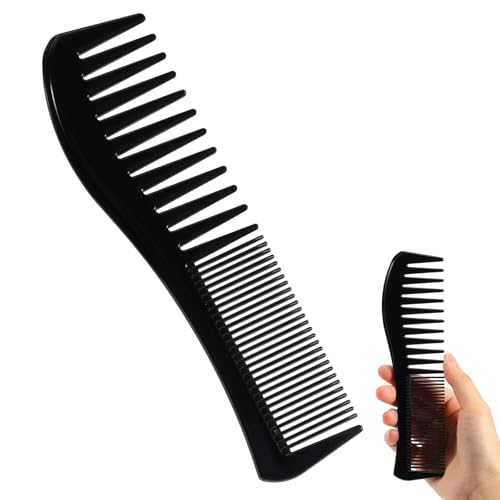
SIMPOR runs a wide-and-fine dual-tooth layout, the same idea as the Kent but at a lower price position and with a bent-grip shape the brand says helps you hold it steady. The material claim is premium acetate, with polished round-tail teeth to protect the scalp, and SIMPOR pitches it as suitable for thick, thin, curly, straight, wet and dry hair. For a household where more than one person will actually pick up the comb, that breadth of use is the reason to consider it over a single-purpose pick.
The reason it sits fourth is transparency. The listing does not publish a length, a weight or full dimensions, so you cannot compare it directly against the Kent or the Paul Mitchell on the numbers that decide comfort. Size is given as Medium, which tells you nothing useful. The material claim is there, the tooth geometry is described, but the missing figures leave you buying on the photograph. That is a real trade-off in this set, because every other pick tells you exactly how long the comb is.
Pros:
- Dual wide-and-fine tooth pattern
- Acetate material claim from the brand
- Bent-grip shape for a steadier hold
- Polished round-tail teeth per the listing
- Middle price position of the five
Cons:
- No published length, weight or full dimensions
- Size listed only as Medium
- The slowest seller of this set
- Marketing breadth ("all hair types") does the work of specifications
5. AFT90 Carbon Fiber Cutting Comb — Best budget pick
The cheapest of the five and a fine cabinet backup, but the design leans toward cutting, not gentle daily detangling.

Best for: a cheap backup or travel comb Skip it if: detangling thick tangles is the main job
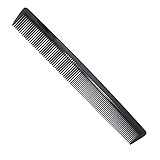
AFT90 lists an 8.15 in length in its title and 0.1 x 8.5 x 1.2 in dimensions in its specifications, which is the second-longest total length in the set. It is a cutting comb rather than a detangling comb, with a fine end and a wider end, and AFT90 says it is made from carbon fiber for a light, static-free feel. The brand also describes rounded teeth designed to avoid scratching the scalp.
Two things to weigh. A cutting comb's wide side is not usually as generously spaced as a dedicated detangling comb's wide teeth, which means it will handle light passes on fine hair but struggle on a tangled section. And on a purely commercial signal, AFT90 sells slower here than the Paul Mitchell and the Kent, which is a soft data point but a real one when brands publish similar material claims.
Buy it as a second comb: one for the bathroom, one for a gym bag, one for a work drawer. As the only comb in your rotation, either the Paul Mitchell or the Kent is the better spend on thinning hair.
Pros:
- Cheapest of the five
- 8.15 in length, second-longest here
- Carbon fiber and anti-static claim
- Dual fine-and-wide tooth pattern
- Rounded teeth per the listing
Cons:
- Designed as a cutting comb, not a detangler
- Wide end likely less generously spaced than a dedicated wide-tooth comb
- No dedicated handle
- Sells slower than the top two in this set
Why tooth spacing decides this, not bristle count
Most comb guides compare length and material. Length matters, material matters, and neither of them is what decides a comb for thinning hair. Tooth spacing is.
Thinning hair fails in one specific way when you comb it: a tooth catches a fine strand at a tangle, the strand does not slide out of the way, and the comb pulls the strand from the follicle instead. The fix is more room between the teeth, so tangles present themselves to the tooth rather than getting rammed through it. That is why every pick in this list is either a dedicated wide-tooth design (Paul Mitchell, HYOUJIN) or a dual-tooth comb where the wide side does the detangling work (Kent, SIMPOR, AFT90).
Two practical implications:
- On a dual-tooth comb, use the wide side only when detangling. The fine side is for finishing dry hair, not for pulling through knots.
- Move from tip to root, not root to tip. Working the last inch clear first stops a tangle at your crown from cascading down the full length.
A comb cannot regrow hair. It can, however, stop being the reason more of it ends up on the floor.
How thinning hair changes what you should look for
Four attributes matter more than they would on thick hair.
- Polished teeth. Injection-molded teeth carry a fine seam down each tooth. On thick hair you never feel it. On fine, shedding hair, that seam catches. Hand-polished teeth, like Kent describes, do not.
- Weight. A lighter comb encourages slower, gentler passes, because you are not fighting the tool's momentum. The Kent (1.06 oz) and the Paul Mitchell (1.41 oz) are the lightest picks here.
- Anti-static behaviour. Static separates fine strands, and separated strands tangle again the moment you stop combing. Carbon fiber, which HYOUJIN and AFT90 both claim, is one route to this. Acetate, as Kent and SIMPOR describe, is another.
- Length that clears a full pass. If you are working shoulder-length or longer hair, a 7.28 in comb (Kent) is fine but not ideal. The 9.45 in Paul Mitchell and the 11 in HYOUJIN do it in fewer passes, and fewer passes means less handling.
None of these are exclusive. The winner picks up three of the four; the premium pick picks up the one it misses.
What to check before you buy
Before you order any of these, walk through the listing with these questions in mind:
- Does the brand publish a length in inches? If not, you are guessing on comfort. Two of the five picks publish full dimensions, one publishes length only, one publishes neither.
- Is the tooth surface described as polished, buffed or hand-finished? Those words do work for thinning hair. "Smooth" alone does not.
- Does the listing say wide-tooth, or is it a fine comb with a wide end? Cutting combs and dressing combs often have a wide end but the spacing is narrower than a dedicated detangler.
- If material matters to you for halal reasons, does the brand name a specific material? Cellulose acetate, carbon fiber and premium acetate are three different claims. None of them are certification, but they are more useful than silence.
If two of those four are missing from a listing, the comb is a gamble on fit. Move to a pick that answers all four.
Which pick fits which routine?
- Fine hair, no heat styling, want one job done well: Paul Mitchell Detangler.
- Fine hair, one comb for detangling and finishing: Kent 16T.
- Any thickness, blow-drying is part of the routine: HYOUJIN 601.
- Shared bathroom, mixed hair types across the house: SIMPOR.
- You already own a good comb and want a backup: AFT90.
If none of these five profiles is you, the question to ask is which one is closest, and what one attribute you would change. Longer than the Kent, lighter than the HYOUJIN, cheaper than the Paul Mitchell: those are trade-offs across the same shortlist, not reasons to start over.
The verdict
The best halal wide tooth comb for thinning hair in this set is a two-track answer, because material transparency and comb geometry point at slightly different picks.
If your priority is a gentle daily detangler and you are comfortable emailing the brand for a material declaration on the halal question, the Paul Mitchell Detangler Comb is the pick. Nine and a half inches, 1.41 oz, a thin flat body, and a dedicated wide-tooth geometry are the right combination for fine, shedding hair, and Paul Mitchell publishes enough of that specification to buy without guessing.
If your priority is material transparency and you want one comb to replace two, the Kent 16T Tortoise wins. Kent is the only brand in this set that names its material as cellulose acetate and describes it as plant-derived, and the saw-cut, hand-polished teeth are the specific finish detail that protects fine strands.
The cutoff is length. Above shoulder-length hair, the Paul Mitchell's 9.45 in body clears a pass the Kent's 7.28 in body cannot. Below shoulder-length, the two are close enough that the material claim tips it toward Kent.
FAQ
Is a wide tooth comb actually better for thinning hair?
A wide tooth comb is better for thinning hair because the extra space between the teeth lets tangles present themselves to a single tooth rather than being forced through a dense row. On fine, shedding hair, that difference is the difference between a strand sliding free and a strand being pulled from the follicle. Every pick in this guide uses wide-tooth spacing for exactly that reason.
Is the Paul Mitchell Detangler worth it over the AFT90?
The Paul Mitchell Detangler is worth it over the AFT90 if daily detangling is the main job. Paul Mitchell's comb is a dedicated wide-tooth design at 9.45 in and 1.41 oz, while the AFT90 is a cutting comb whose wide end is narrower than a dedicated detangler's spacing. Buy the AFT90 as a cheap backup or travel comb; buy the Paul Mitchell as your primary.
What tooth spacing counts as wide enough?
What tooth spacing counts as wide enough is not a number the listings publish, so you judge it from the photograph and the product's stated purpose. A dedicated detangling comb, like the Paul Mitchell and the HYOUJIN here, spaces teeth for wet, knotted hair. A cutting or dressing comb's wide end is narrower. If the listing calls the tool a detangler, the geometry is designed for shedding hair.
Paul Mitchell versus Kent 16T: which one for shoulder-length hair?
Paul Mitchell versus Kent 16T comes down to length and material. At shoulder length and above, the Paul Mitchell's 9.45 in body clears a full pass the Kent's 7.28 in body needs two of. At jaw length and below, the Kent's dual fine-and-wide pattern and cellulose acetate claim tip the balance. Weight is close: 1.41 oz against 1.06 oz.
What should I avoid in a comb for thinning hair?
What you should avoid in a comb for thinning hair is molded teeth with a visible seam, dense fine-tooth spacing as your primary comb, and any listing that does not publish either dimensions or a material claim. Seams catch fine strands; fine teeth pull tangles instead of releasing them; and a listing that describes nothing measurable is a listing you are buying on marketing alone.
If certification is genuine for you, and the listing does not label the comb as halal, treat the material claim as a starting point and confirm with the brand before ordering. Kent's cellulose acetate note is the most specific in this set, and Paul Mitchell's dedicated wide-tooth geometry is the strongest fit for daily use on fine, shedding hair. Start with whichever of those two matches your length and routine, and keep a cheap backup like the AFT90 in a travel bag so you never reach for a random hotel comb halfway through a trip. A comb cannot replace what you have already lost, but the right one stops adding to the pile.