Best Detangling Hair Brush for Hair Loss Worries

Six detangling brushes ranked for anyone worried about strands in the sink. Which flexible bristle design pulls the least, and why brush choice only goes so far.
By Mateo CallahanUpdated 15 min read
On this page
- Best detangling hair brush for hair loss at a glance
- Can a brush really reduce hair loss?
- How I narrowed the field to six
- 1. Wet Brush Original Detangler Hair Brush — Best overall
- 2. Tangle Teezer Ultimate Detangler Brush — Best premium
- 3. Tangle Teezer Fine Ultimate Detangler Brush — Runner-up
- 4. Crave Naturals Glide Thru Detangling Brush — Best for beginners
- 5. HIPPIH Boar Bristle Hair Brush Set of 2 — Best for heavy use
- 6. Ninabella Detangler Brush — Best for families
- Flexible bristles versus boar: which pulls less?
- What to check before you buy
- How to brush without yanking strands
- The verdict
- FAQ
The best detangling hair brush for hair loss worries is the Wet Brush Original Detangler, a 2.4 oz brush whose flexible IntelliFlex bristles give way through knots instead of ripping through them. If your hair is fine or color-treated, the Tangle Teezer Fine Ultimate Detangler is the gentler choice, with teeth a grade softer than the standard model. Here's how the price tiers actually break down. The entry picks cover daily wet-brushing at the lowest cost, the mid tier adds multi-brush value, and the premium picks buy patented two-tiered teeth for stubborn knots.
Best detangling hair brush for hair loss at a glance
| Pick | Bristle type | Weight | Price |
|---|---|---|---|
Best overall Wet Brush Original Detangler |
Flexible IntelliFlex | 2.4 oz | Check Price |
Best premium Tangle Teezer Ultimate Detangler |
Two-tiered regular-flex | 3.21 oz | Check Price |
| Two-tiered soft-flex | 2.57 oz | Check Price | |
Best for beginners Crave Naturals Glide Thru |
Soft plastic | 3.2 oz | Check Price |
Best for heavy use HIPPIH Boar Bristle Set of 2 |
Boar + nylon pins | Not listed | Check Price |
Best for families Ninabella Detangler Brush |
Flexible nylon | 2.12 oz | Check Price |



One note before the picks: HIPPIH is the only entry without published weight or dimensions, so the table marks that cell honestly rather than guessing.
Can a brush really reduce hair loss?
Can a brush really reduce hair loss? Not the way a treatment can. A brush cannot stop shedding that comes from hormones, stress or a medical condition. What a gentle brush can do is cut the strands you lose to breakage and mechanical tugging while you detangle. That's a real difference, and it's the only claim any of these listings supports.
None of these six brushes is marketed as a hair loss treatment, and none should be bought as one. The search behind this guide asks for a brush that suits people worried about losing hair. What that actually means, in the data, is a brush that pulls as little as possible. So that is the lens here.
- Flexible bristles that bend around knots reduce the yank that snaps fragile strands
- Rounded tips protect the scalp during longer brushing sessions
- Lighter brushes are easier to control, which means fewer aggressive strokes
The Wet Brush listing claims its IntelliFlex bristles cause 55% less breakage. That is the manufacturer's figure, not a measurement I made, so treat it as a claim. But the direction is right. If shedding worries you, the deciding question is how the brush handles a knot, not how it looks on a shelf.
How I narrowed the field to six
I started by cutting anything that failed on gentleness, because that is the whole point for this reader. Three disqualifiers did most of the work.
- Rigid, bead-tipped bristles. Brushes with hard beads that dig into the scalp got cut first. The Crave Naturals listing specifically contrasts its soft plastic bristles against "brushes with beads," and that's the line I drew.
- No stated gentleness feature. Every survivor had to describe flexible teeth, rounded tips or soft-flex bristles in its own listing. Marketing language, yes, but at least the maker is aiming at the right target.
- Wet-use ambiguity. A brush that can't work on wet, conditioned hair is a problem, because wet detangling is where most breakage happens. All six here claim wet and dry use.
What survived splits into three groups. The two flexible-bristle picks, Wet Brush and Ninabella, are light and built for daily wet detangling. The two Tangle Teezers use a patented two-tiered tooth design and sit at the top of the price ladder. The Crave Naturals and HIPPIH round out the middle, one as a simple starter and one as a two-pack.
I compared the published specifications side by side rather than relying on any single feature bullet. Weight, dimensions and bristle description carried the most weight, since those are the fields a shopper can actually check against the live listing.
1. Wet Brush Original Detangler Hair Brush — Best overall
The Wet Brush Original earns the top spot because its flexible bristles and light 2.4 oz body make it the easiest brush here to pull through a wet knot without a yank.
Best for: anyone who brushes wet hair daily and wants the least pull Skip it if: you want a smoothing finish from natural bristles
This is the pick I'd hand most people worried about shedding. At 2.4 oz it's featherlight, and the 1.6 x 8.8 x 2.8 in body is a standard paddle shape that's easy to control. Control matters here. A brush you can guide gently is a brush that snaps fewer strands.
Wet Brush calls its bristles IntelliFlex and says they glide through tangles "with 55% less breakage." That's the maker's claim, and I'd treat the exact number as marketing rather than fact. What's not in dispute is the design intent: flexible bristles that bend around a knot instead of forcing through it. The listing also states the brush works on wet or dry hair across straight, curly, textured, thick and wavy types.
Within this set, it's the cheapest of the six and the one buyers here reach for far more often than the rest. The trade-off is finish. Unlike the boar-bristle HIPPIH, it won't distribute scalp oils or leave that polished shine. It detangles first and last.
Pros:
- Lightest paddle option at 2.4 oz
- Flexible IntelliFlex bristles designed to bend around knots
- Cheapest of the six picks
- Works on wet or dry hair, all textures
- The pick buyers here choose most often
Cons:
- No smoothing or oil-distributing finish
- Manufacturer's 55% breakage claim is unverified
- Only one seller lists it
- A single color option in this listing
2. Tangle Teezer Ultimate Detangler Brush — Best premium
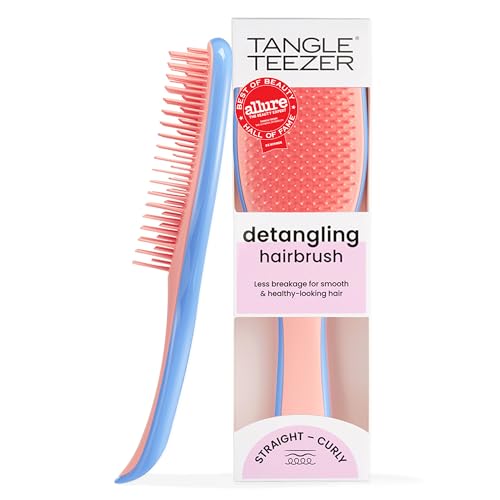
The Tangle Teezer Ultimate is the premium pick for thick, knot-prone hair, using a patented two-tiered tooth design that grips stubborn tangles the flat-bed brushes can't.
Best for: straight to wavy hair that needs a firm grip on knots Skip it if: your strands are fine or color-treated
This is the most expensive pick here, and the money buys a specific design. Tangle Teezer's listing describes patented two-tiered teeth: long flexible teeth that detangle and remove knots, and short teeth that smooth strands in the same stroke. For someone with dense, easily matted hair, that dual action can mean fewer repeat passes, and fewer passes means less mechanical stress on the hair.
At 3.21 oz it's the heaviest of the four picks with published weights, and the 2.7 x 10 x 2 in body is longer than the Wet Brush. It's a two-handed shower brush rather than a slip-in-the-bag one. The maker positions it as ideal for spreading conditioning masks evenly, which is a genuine reason to keep it in the shower.
The catch is match. This is the regular-flex model, tuned for straight to wavy strands. If your hair is fine or color-treated, its softer sibling below is the smarter buy. It also sells more slowly than the top picks here, so it's a considered choice, not the default.
Pros:
- Patented two-tiered teeth grip and smooth in one pass
- Firm regular-flex teeth suit thick, knotty hair
- Doubles as a shower brush for masks and conditioner
- Handle shape built for a controlled grip
Cons:
- Most expensive pick in this set
- Heaviest at 3.21 oz
- Too firm for fine or color-treated hair
- Sells slower than the top two picks here
3. Tangle Teezer Fine Ultimate Detangler Brush — Runner-up
This is the gentlest match in the lineup for fragile hair, with soft-flex teeth a full grade softer than the standard Ultimate model.

Best for: fine, thin or color-treated hair that snags easily Skip it if: you have thick, coarse hair that needs more grip
If shedding worries you and your hair is fine, this is arguably the most relevant pick in the guide. Tangle Teezer built it around one idea: the teeth are "a grade softer than our original ultimate detangler," aimed squarely at vulnerable, color-treated, thin and fine strands. Softer teeth apply less force, and less force is the whole game for fragile hair.
It shares the same patented two-tiered tooth technology as the premium model, long teeth to detangle and short teeth to smooth. At 2.57 oz it's lighter than its firmer sibling. The listed dimensions of 0.5 x 4.72 x 2.36 in describe a slim, compact profile that's easy to hold without over-gripping.
It's the second-most expensive here, and it's the slowest seller of the six. That's less about quality than about audience: fine-hair brushes are a narrower market. The honest trade-off is versatility. The soft teeth that protect fine hair won't bite into thick, coarse tangles as well as the regular model. Buy it for the hair type it names, not as a do-everything brush.
Pros:
- Soft-flex teeth a grade softer than the standard model
- Purpose-built for fine and color-treated strands
- Same two-tiered detangle-and-smooth design
- Lighter than the premium Tangle Teezer at 2.57 oz
Cons:
- Second-most expensive pick
- Too soft for thick, coarse hair
- Slowest seller of the six
- Only one seller lists it
4. Crave Naturals Glide Thru Detangling Brush — Best for beginners
The Crave Naturals Glide Thru is the easiest first detangler to buy, with simple soft plastic bristles and clear guidance built into the listing itself.

Best for: someone buying their first detangler for the whole family Skip it if: you want a compact brush for a small bag
There's no learning curve here, which is exactly why it lands as the beginner pick. The listing spells out the method: work in small sections, and wash with conditioner first for stubborn tangles. That's the right technique for reducing breakage, and it's rare to see it printed on the box.
Crave Naturals contrasts its soft plastic bristles against brushes with beads, saying its bristles "massage the scalp and increase circulation." I'd read the circulation-and-growth wording as a marketing claim, not proof. The gentle-on-the-scalp intent, though, is real and useful for anyone brushing carefully. At 3.2 oz it's on the heavier side of this group.
The listing gives its footprint as 7.5" x 3", which is a full-size brush rather than a travel one. It's the second-cheapest here, so it's easy to justify as a shared household brush. The trade-off against the lighter picks is portability. If you want something that vanishes into a purse, the Ninabella below is slimmer. As a no-fuss starter for the bathroom drawer, this is the safe call.
Pros:
- Second-cheapest pick in the set
- Soft plastic bristles, no scalp-digging beads
- Listing includes step-by-step gentle technique
- Marketed for kids and sensitive scalps alike
Cons:
- Heavier at 3.2 oz
- Full-size footprint, not travel-friendly
- Growth and circulation claims are unverified
- Single color in this listing
5. HIPPIH Boar Bristle Hair Brush Set of 2 — Best for heavy use
The HIPPIH set is the value play for busy households, giving you two brushes and a boar-bristle finish the plastic picks can't match.

Best for: households that want two brushes and a smoothing finish Skip it if: you need published weight and size figures before buying
This is the only pick that arrives as a pair, and that's its whole argument. Two brushes for one mid-tier price means one for the bathroom and one for the bag, or two people who stop fighting over a single brush. For a busy home, that convenience is worth something real.
The design mixes boar bristles with nylon pins. HIPPIH says that combination detangles while spreading natural oils and helping remove dandruff and dirt from the scalp. The boar-bristle element is the differentiator here: it's the only pick that offers a genuine smoothing, oil-distributing finish rather than pure detangling. The listing also claims it generates no static, which is a nice touch in dry winter air.
Here's the honest weakness. This is the only pick with no published weight and no dimensions, so you can't compare its size against the others before it arrives. It's also the second-most-slowly-selling here. If you value a smoothing finish and two brushes over spec transparency, it delivers. If you want to know exactly what you're getting first, the specced picks are safer.
Pros:
- Two brushes in one package
- Boar bristles add a smoothing, oil-spreading finish
- Nylon pins claimed to help lift dandruff and dirt
- Listing claims no static buildup
Cons:
- No published weight or dimensions
- Second-slowest seller in the set
- Boar bristles less relevant if you only want detangling
- Fixed color combination
6. Ninabella Detangler Brush — Best for families
The Ninabella is the lightest brush here at 2.12 oz, a slim, anti-static detangler that travels well and shares easily.

Best for: shared bathrooms and travel where light weight matters Skip it if: you want the most established detangling name
At 2.12 oz, this is the lightest pick in the guide, lighter even than the Wet Brush. The 1.57 x 8.66 x 2.76 in body is slim and ergonomic, and Ninabella pitches it for the gym bag, the airport and the carry-on. For a family passing one brush around, or for someone who wants a detangler in every bag, low weight and a slim profile matter.
The gentleness story tracks the leaders. Ninabella describes flexible bristles that "give way and glide through knots instead of ripping through them," plus rounded tips that pass gently over the scalp. It names fine, thick, long and curly hair as suitable, and claims to reduce breakage. Same intent as the Wet Brush, at a mid-tier price.
There's a sustainability angle too: the body is made from recycled post-consumer plastic with cardboard packaging. That won't help your hair, but it may matter to you. The trade-off is pedigree. It doesn't carry the established detangling name the Wet Brush and Tangle Teezer do, and it sits mid-pack on sales here. If you weigh weight and versatility over brand, it's a strong buy.
Pros:
- Lightest pick at 2.12 oz
- Slim, ergonomic body for bags and travel
- Flexible bristles with rounded, scalp-friendly tips
- Recycled-plastic body and cardboard packaging
Cons:
- Less established name than the leaders
- Mid-pack on sales in this set
- Single color in this listing
- Only one seller stocks it
Flexible bristles versus boar: which pulls less?
Flexible bristles versus boar is the real fork in this category, and for anyone worried about shedding, the answer leans one way. Flexible plastic or nylon bristles bend around a knot and release it. Boar bristles smooth and distribute oil, but they don't flex the same way through a tight tangle.
Here's how the six sort out:
- Flexible plastic or nylon: Wet Brush (IntelliFlex), Ninabella, Crave Naturals soft plastic
- Two-tiered patented teeth: both Tangle Teezers, with the Fine model softer
- Boar plus nylon pins: HIPPIH, the only smoothing-focused pick
If detangling with the least pull is the goal, the flexible and two-tiered groups do that job. Boar bristles earn their place as a second brush for a polished finish after you've detangled. Using boar bristles alone on a bad knot means more strokes, and more strokes on fragile hair is exactly what you're trying to avoid. Match the bristle to the job, and for shedding worries, that job is releasing knots gently.
What to check before you buy
You can judge a detangling brush you've never held by reading a few fields on the listing. Here's what actually tells you something.
- Bristle flexibility. Look for words like flexible, soft-flex or "give way." A brush that describes rigid bristles or beads is aimed at a different job.
- Weight. Under 3 oz is easy to control for gentle, careful strokes. The picks here run from 2.12 oz to 3.21 oz where weight is published.
- Wet-use rating. Wet, conditioned hair is where breakage happens most, so confirm the brush is rated for wet and dry.
- Hair-type match. Fine and color-treated hair wants the softest teeth available; thick, coarse hair wants firmer grip.
- What's missing. If a listing skips weight and dimensions, like the HIPPIH set, you're buying with less information. That's a fair trade for a two-pack, but know it going in.
Read the bristle description first and the color second. Color is the easiest thing to fixate on and the least important for your hair.
How to brush without yanking strands
The brush matters less than how you use it. A gentle brush used roughly still snaps hair, so technique carries real weight for anyone shedding.
- Start at the ends. Work the bottom few inches free first, then move up. Starting at the roots drags every knot down into a bigger one.
- Hold above the knot. Grip the hair above where you're brushing so the pull lands on your hand, not your scalp.
- Work in small sections. The Crave Naturals listing recommends this directly, and it's right. Small sections mean less force per stroke.
- Condition first for stubborn tangles. Slip helps the brush glide, which is why several of these are marketed as shower brushes.
- Go slow. Speed is where breakage lives. A few extra seconds saves strands.
None of this stops hair loss with a medical cause. But it does cut the strands you lose to force, and that's the part a brush can control.
The verdict
If your hair is average to thick and you want the least-fuss gentle brush, the Wet Brush Original Detangler is the pick. It's the lightest paddle at 2.4 oz, the cheapest of the six, uses flexible bristles built to bend around knots, and it's the brush buyers here reach for most. That combination of low pull, low price and easy control makes it the right default for most people worried about shedding.
If your hair is fine, thin or color-treated, the choice flips to the Tangle Teezer Fine Ultimate Detangler. Its teeth are a grade softer than the standard model, purpose-built for vulnerable strands, and it carries the same two-tiered detangle-and-smooth design. The cutoff is hair fragility: sturdy hair is happiest with the Wet Brush, fragile hair is safer with the Fine Tangle Teezer.
The Fine model's exact advantage over the winner is force. Softer teeth apply less of it, and for hair that snaps easily, that margin is the whole point. The premium regular Tangle Teezer is the pick if your knots are severe and your hair is robust enough to take a firmer tool. Everything else here fills a narrower role.
FAQ
Can the best detangling hair brush for hair loss stop shedding?
The best detangling hair brush for hair loss cannot stop shedding that comes from hormones, stress or a medical condition. What a gentle, flexible-bristle brush does is reduce the strands you lose to breakage and tugging while detangling. That's a genuine benefit, but it's mechanical, not medical. If your shedding is sudden or heavy, see a professional rather than shopping for a brush.
Is a premium detangler worth it over an entry pick?
A premium detangler is worth it only for specific hair. The Tangle Teezer Ultimate uses patented two-tiered teeth that grip stubborn knots the flat-bed brushes struggle with, which helps thick, matted hair. For average hair, the 2.4 oz Wet Brush handles daily detangling at the lowest price here. Pay up only if severe tangles make repeat passes a daily problem.
Which weight and size should I look for in a detangling brush?
The weight and size that suit gentle brushing sit under 3 oz for easy control. Among these picks, the Ninabella is lightest at 2.12 oz, the Wet Brush follows at 2.4 oz, and the Tangle Teezer Ultimate is heaviest at 3.21 oz. Lighter brushes are easier to guide slowly, and slow, controlled strokes are what save fragile strands from snapping.
Wet Brush or Tangle Teezer Fine for thin hair?
Wet Brush or Tangle Teezer Fine both suit thin hair, but the Fine model edges it. Its teeth are a grade softer than any other Tangle Teezer, built specifically for fine and color-treated strands, so it applies the least force. The 2.4 oz Wet Brush is gentler than most brushes too, and it's cheaper. For the most fragile hair, the Fine model wins.
What detangling brush mistake causes the most breakage?
The detangling brush mistake that causes the most breakage is starting at the roots. Dragging a brush from the scalp down forces every knot into a bigger mat, and that's where strands snap. Start at the ends, work upward in small sections, and hold the hair above the knot so the pull lands on your hand. Slow strokes on damp, conditioned hair lose the fewest strands.
Your next step is simple: pick by hair type, not by color. If your hair is average to thick, start with the Wet Brush Original, since it's the lightest, cheapest and least-fuss way to detangle with minimal pull. If your strands are fine or color-treated, go straight to the Tangle Teezer Fine. No brush treats hair loss, but the right one stops adding to the problem with every stroke, and that quiet, daily saving is worth choosing carefully for.